
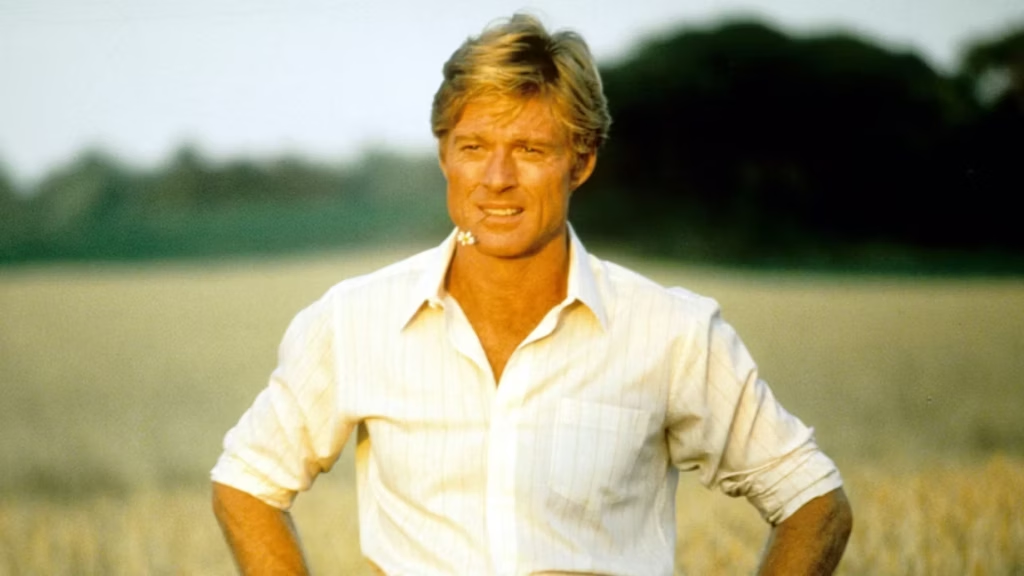
The Natural is a baseball movie that captures the mythology of the game.

Baseball movies are like some types of baseball games. Some load up on a slugfest hits and offense and then countered by hurricane speed power pitching. Others are about the comedy of errors sometimes occurring on the diamond. Others focus on one unique player who captures people’s imagination, much like in reality the superstar who people specifically pay to see. This post is summary and commentary on my favorite baseball movie, 1984’s The Natural. Be warned there are spoilers here!
Plot and Characters
The Natural is Based on Bernard Malamud’s novel of the same name. It embraces both classic Greek mythology and The Legend of King Arthur. It also addresses themes like temptation, lust, and sports gambling. Depression era pitching prospect Roy Hobbs (played by Robert Redford) has been given the gift of playing baseball on a near supernatural level from the time he was a youngster. Hobbs carves “a special bat” called Wonder Boy from a tree split by lightening, like Arthur pulling his sword from a stone. Roy Leaves his girlfriend Iris (Glenn Close) behind but promises to “send for” her later. The teenaged Roy hops a train to Chicago for a major league tryout with the Cubs.
He meets a mysterious woman in black named Harriet Bird (played by Barbara Hershey) who is on a spree of killing top athletes. Roy strikes out The Whammer (based on Babe Ruth) at a train stop challenge. Harriet witnesses this, and picks a new victim. She lures Roy to her hotel room. She then shoots Roy, leaving him for dead and committing suicide. Roy himself survives, but it takes him 16 years to make another run at the big leagues. When given the chance by the floundering New York Knights, Roy and Wonder Boy hit titanic homers together. He’s unstoppable and the toast of baseball. The once lowly Knights are in contention to win the pennant. The once empty stadium is drawing crowds instead of flies.
After he meets the gorgeous Memo Paris ( played by Kim Basinger and who too, of course, wears black) he’s seduced and goes into a terrible slump. Memo’s uncle happens to be the Knights manager, Pop Fisher (Wilfred Brimley), who had forewarned Roy that his niece was “bad luck.” Roy whiffs even worse than today’s sluggers who think three K’s a game are ok. Now Roy can’t hit a beach ball with an oar during this slide.
Later, Iris is living in Chicago and reads of Roy’s exploits. Despite not having seen him in 16 years, she shows up to see Roy play. He continues to hit nothing but air at the plate. Iris stands up in the stands, wearing a white dress and hat. The afternoon sunlight is behind her during his next at bat. Her “halo” lifts Memo’s curse. Roy homers and goes back on another hitting tear. He and Iris awkwardly try to reconcile after the game at a candy shop, but realize they aren’t adolescents anymore.
Memo’s sponsor named Gus Sands, a major gambler, is worried Memo has lost her spell on Roy. Gus is in cahoots with the Knights part owner, a sleazy judge. The Judge and Fisher, also a part owner, have an odd contract. If the Knights win the pennant then Pops gets the team. If the Knights go down, The Judge sends Fisher packing. Sands and The Judge are not going to permit a level playing field.
First Gus has Memo poison Roy at a team party. He ends up in the hospital on the eve of the Knights clinching their unlikely pennant. Roy’s doctor discovered that the bullet he took years ago has disintegrated his stomach. Playing baseball is out and only rest can possibly heal the wound. However, The Judge and Gus are taking no chances on Roy rising to the occasion. The Knights lost the final season games without Roy and could only tie for the league lead. There must be a playoff game to decide who goes to the World Series.
Like Shoeless Joe Jackson in 1919, Roy is offered big money to throw the game. In the novel, Roy holds up his end of the deal and strikes out to end the game. In the movie, Roy plays despite his doctor’s orders and his bleeding stomach. He refuses the bribe money and smashes a towering homer that detonates the lights to win the pennant. Iris once again plays a role in inspiring him, sending Roy a message before his last bat with the pennant on the line. Iris had told Roy before that she had son. Now she tells him it was his son, now about 16.
My Take On The Movie
Roy Hobbs’s story, win or lose, shows the vulnerability ballplayers face. One accident, injury, tragic shooting, or poor decision can derail their careers in an instant. Baseball as metaphor for life is clear. If you take your eye off the ball and lose focus via money, sex, or hubris, you will strike out. The only way to homer is to use your gift through hard work and humility.
Legends and Myths
The allusions to the King Arthur story are hardly subtle. Roy is Arthur, and Wonder Boy is Excalibur. He plays for the Knights (as in Knights of the Round table). Pops is The Fisher King, a man who tries to protect the Knights and attain the Holy Grail (the pennant). Fisher, who can’t even get a drink of clean water from the dugout, needs a hero to rise above his predicament. Only those with pure vision, in Arthurian legend, can see and capture the Grail. Roy’s weakness for beauties in black dresses tarnishes his pursuit. The pitcher for the Knights is also impure, having taken money from The Judge to throw the playoff game to neutralize Roy.
There’s also some Greek mythology as well. On the train Harriet educates Roy on Homer’s tales, to which Roy admits a “homer” to him means four bases. Lightening strikes from the gods (specifically Zeus) can give either power or punishment. In Roy’s first at-bat in the majors, he literally knocks the cover off the baseball just as lightening strikes. The light hitting team adds lightening logo to their jerseys and they improve at the plate. However, in the playoff game lightening hits again, but Wonder Boy is split in two. Batboy Bobby Savoy had asked Roy earlier to help him make a bat. Roy uses The Savoy Special, and he clouts a Hercluean home run into the lights to win the pennant.
The Natural combines myth and legend, so it doesn’t aim for total baseball realism. Yet the movie does allude to baseball history, such as with the gambling based on the 1919 World Series. However, it’s 1939 in the movie, and sports bribes aren’t immune to inflation. Shoeless Joe and his seven cohorts got $5,000 each to lose. Roy is offered $20K. Earlier in the movie Roy apparently has forgotten baseball history himself. He and Memo have dinner in a five star restaurant with Gus, a well known gambler. Commissioner Landis banned the corrupt White Sox players for life in 1921. After that why would any ball player risk even appearing in public with a gambler?
Also, the contract that The Judge and Pops have is ludicrous. Why would a part owner be allowed to stop his partner from winning and be rewarded for it? I would think Commissioner Landis would have cancelled such a deal in reality. Nonetheless, a similar plot was used in the Major League movie franchise of the late 80’s and early 90’s. The Cleveland Indians were lead by a scheming high society lady owner purposely undermining the team to force it to lose. She wanted poor attendance so she could get MLB approval to send the Indians to South Florida. The comedy here is that back then the real Indians needed no help in finishing last annually. They could be eliminated from the pennant race by July 4th all on their own. Nobody showed up in the stands to find out anyway.
Roy being a top pitching prospect and then being a top hitter parallels Babe Ruth. Ruth was one of the game’s best pitchers until it was discovered he could hit like the devil. Yikes, what took management so long?!
Robert Redford specifically wanted Roy to have number 9, the same number his hero and legend Ted Williams. Redford was a left handed batter like his idol as well.
Harriet Bird’s stalking and shooting Roy was based on the real life attempted murder of Phillies star Eddie Waitkus. Teen aged fan Ruth Anne Steinhagen was obsessed with him. He had previously played for the Cubs, Ruth’s team. When he was traded to the Phillies in 1949, she lost her mind. Eddie was staying at a hotel and she had a note delivered to him. Thinking it was from a grown woman, Eddie on a lark decided to meet her, where she shot him. Like Roy he recovered, though he was was back to baseball in a year, not 16.
Speaking of recovery, I don’t get the doctor’s diagnosis and prescription after Roy was sent to the hospital. The doctor tells Roy he can’t play baseball again. He can’t even be in the the playoff game the next day. For the reason, some internet theories have speculated Doc was being paid by The Judge to ground him! He scares Roy with the possibility of his stomach going nuclear on him in the middle of a game. This of course, would be fatal.
Roy was a patient in a maternity hospital since it was close by when he was poisoned. So presumably Roy gets a stomach diagnosis by an OB/GYN? If I’m Roy, I’d want a second opinion from a gastrointestinal specialist. Also, the doctor either didn’t know or care that Roy had not played ball for 16 years while the bullet was inside him. Yet his stomach had fallen apart anyway, so how would avoiding baseball now cure it? Doc also tells him his age is a major factor in not clearing him to play. Roy is perhaps 36? OK, Roy’s old for a rookie, but he’s not on Social Security yet! Would he clear Roy to play with that same ailment at 21?
Hyperbole and Symbolism
You can’t have a legend without some exaggeration. If Roy’s cannon shot homer into the light tower was measured today, it might read 700 feet! If Roy snuck the last pitch past Pesky’s pole at 302 feet in Fenway Park, would it have been as dramatic? Though he certainly could hit, Robert Redford didn’t have the physique you’d picture hitting the ball a quarter mile. He was probably 5’9″ and no more than 160. He was hardly a pumped lumberjack type like Barry Bonds who once homered off a broken bat.
As for symbolism, when Roy homers after Iris stands, he shatters an outfield clock. He’s fighting time throughout the movie. He’s lost 16 years. He won’t have many more chances to play great baseball. For one moment Iris as angel grants him the ability to stop Father Time’s effects.
The last at-bat climactic scene shows a few other forms of symbolism. Roy, via Wonder Boy’s split, is broken again. Yet he’s renewed by young Bobby’s bat, just like baseball renews with the youth of spring every year. Roy also hits the homer off “young John Rhodes.” The pitcher is left handed fire balling blond from the Nebraska farm lands, the spitting image of Roy when he left for the Cubs tryout. Roy is competing with his earlier self’s hopes, dreams, and abilities. Aren’t we all doing this as time marches on?
The Natural ends with Roy meeting and playing ball with his son, in the same corn fields he grew up in. The torch, or the ball is passed on.